Optimize your community wisdom
I express my appreciation to Jake and firecat1991 for inspiring the idea, and to the TNS community, Balaji Srinivasan, and the #writers team including MattHarder, Camellia, neodaoist, plaird, grant and simonep, for providing motivation and working tirelessly to better our community.
I aspire to continue following their remarkable capability and dedication.

Fig. 1 Optimalist Isaac Asimov, acquire your exclusive Optimalist NFT
“The saddest aspect of life right now is that science gathers knowledge faster than society gathers wisdom.” Isaac Asimov
“Gotcha Isaac, but what about using technology to improve collective wisdom?
Why not Optimize the wisdom of a community!” davesoma.eth
“Ok, let’s improve the species!” Optimalist Isaac Asimov
- Artificial Intelligence and Collective Consciousness
- Chapter Two, Cracking the Code of the Wise, Lee Kuan Yew
The first time I utilized ChatGPT, a natural language processing tool developed by OpenAI, I immediately realized the immense power at my disposal. The language model appeared highly responsive and accurate in comprehending the meaning of my prompt, delivering articulate and detailed answers that were logically sound. At times, it even grasped subtler aspects of my thoughts better than many human conversational partners, enhancing my thought processes through a clearer verbal representation.
What topic are we going to cover:
- Large Language Models
- How thinking works
- Preservation of knowledge
- Pratical Examples
- Cultural Assets
Years ago, I played with Python to train some models by myself, but I quickly realized that the competitive advantage that prevented people from exploiting the opportunities of those tools was the amount of data needed. Now, thanks to large language models, you can interact with an already trained model, and these tools have finally been democratized.
I was struck by the potency of ChatGPT from the moment I first used it. Despite being a Large Language Model and not an AGI (Artificial General Intelligence), and despite the fact that its knowledge cutoff is 2021, the language model proved to be an excellent substitute for a search engine, allowing me to engage in conversation with an astute mentor. I found myself able to refine my phrasing and reasoning through a symbiotic relationship with the model, though I am cautious to verify the information it provides and don’t blindly trust everything it says. It’s important to note that the model is trained on human-generated data, including inherent biases.
“Man has always feared the darkness. And so, he scrapes away at the edges of it with fire. It’s a fragile thing… light. Almost as fragile as the humans who wield it. And yet, here we are, carving our place in the universe, building technology to extend our reach. While insisting that it’s all a product of our ingenuity, our spirit, our prowess. But in the end, when we’re thrust into the darkness, all we’ll have to guide us is the technology we’ve built together. The connections we’ve forged, the light that we’ve cast into the void. And if we’re strong enough to keep it burning, we’ll never have to fear the darkness again.” –
Evangelion, Ritsuko Akagi, Volume 4, Chapter 30.

Fig. 2 Evangelion – Human/Cyborg symbiosis
One of the central themes of “Neon Genesis Evangelion” is the relationship between the pilots and their Evangelions, which are essentially AI-powered symbiotic devices. The Evangelions serve as both weapons and life support systems for the pilots, who must synchronize with them in order to effectively use their abilities.
What remarkable capabilities can a limited Large Language Model like ChatGPT already unlock?
I discovered that my childhood dream had come to fruition.
As someone who was born at the dawn of the internet age and feels like my brain is wired to the web, ChatGPT stands out as the most powerful tool ever created.
My imagination began to run wild with possibilities, and I quickly realized the potential of this new tool. I signed up for a trial account, obtained the API, and started exploring it using Visual Studio Code. I soon realized the potential for creating a chatbot for my blog and decided to try my hand at coding. During the process, I sought suggestions from ChatGPT itself on lines of code I was writing, and I started to think about the long-term consequences of this technology. While it is clear that certain jobs like journalism, education, and law will be impacted, what really captivated my mind was the opportunity to feed the model with vast amounts of writing. I initially thought of this as a way to create a digital clone of myself, but then I realized the significance of leaving a written legacy of my memories. Every article I write becomes a piece of data that contributes to my digital self. This concept made me reflect on the idea that just as our consciousness is built from electrical signals in our neurons, a collective consciousness can be created from the interconnected elements of a hive mind.

Fig. 3 A connection between cells, a connection between thoughts, a connection between people.
It is crucial for the well-being of a community to enhance the health, wealth, and education of all its members. (The Dystopian Present of the United States)
What about improving the synapses as well?

Fig. 4 Perceptrons, neurons, and possibly even a hive mind?
Imagine this image not as a neuron but as a community. In this community, every contribution to discussions has a weight and this weight influences the outcome. The weight of each contribution is determined by an algorithmic democracy, based on the context provided by intellectual athletes who bring a common perspective through the best blend of their intellectual inputs. Repetition of common ideas that emerge during countless discussions on platforms like Discord can lead to the perfect formula, the ideal summary, and the ideal balance between the many ideas, much like ingredients in a recipe create a perfect philosophical dish or better yet, mental supplements that encapsulate the ideas of multiple users.
In essence, we hold the power to shape our culture in a decentralized and truly democratic way, without sacrificing valuable information as its essence is retained.
During my interactions with OpenAI, I realized that often my memories only retain faint traces of past thoughts, occasionally resurfacing as remnants of books read long ago. ChatGPT helps me to bring these lost connections to the forefront, giving more depth and cultural context to my instincts. Its ability to consume large amounts of data is not limited to my own writing, but extends to the writings of an entire community. From these discussions, it may be possible to extract cultural trends and values that are not yet fully apparent, and even shape a culture from its foundations. The idea of applying first principles thinking to engineer a brand new nation is truly captivating to me.
“Just as it is with the members in those bodies which are united in one, so it is with rational beings which exist separate, for they have been constituted for one co-operation.”
Marcus Aurelius
By analyzing vast amounts of data from the community, including writings and discussions, LLMs can extract and perfect key ideas, values and principles. This information can then be used to coordinate the group and give a more practical shape to their beliefs and ideas. Those models have the potential to connect abstract concepts to real-world implementations through digital infrastructure, effectively reshaping the foundation of a culture and creating a sort of engineered nation. With proper training and personal context, chatGPT has the ability to delve deeper into the nuances of a community’s thinking, helping to better understand and refine their values, beliefs and ideas.
Perfecting the hive mind of a community of intellectual athletes has far-reaching philosophical consequences. The refinement of ideas through collective discussions can lead to the establishment of principles and values that effectively coordinate the group and give them a more pragmatic form. The use of digital infrastructure in cyberspace in the future can help connect these ideas to the real world. Unlike human memory, code never forgets, it stores ideas in a distilled format, ready to be deployed or suggested when the time is right. This can be achieved by saving the compressed version of thoughts in a CSV file and retrieving it later, as new experiences or technological advancements provide a more complete picture. When engaging in discussions with a Community Assistant in the future, it will be possible to access archived discussions and choose to either receive the complete decompressed version or a distilled insight. These tools act as creative amplifiers, enhancing not only personal creativity but also the creativity of the community as a whole.
Moreover, by providing the community with its own unique context, it will help to maintain the community’s distinctiveness and prevent it from being lost in the vast sea of the global population, reducing the likelihood of losing its identity and independence, and minimizing the risk of manipulation by any central authority.

Fig. 5 Focus on connecting the .zip file
A practical example.
By using embedding models, The Network State community has the ability to extract and distill the most valuable and thought-provoking ideas from our discussions, preserving them for future reference and implementation. These insights can be retrieved at any time, shared in articles or reports, and used to keep the community updated on the evolution of our collective thinking and culture. Writing is a powerful tool for personal growth, but with OpenAI, we have the means to compress and store the fruits of our thoughts, expanding the limits of our minds. In essence, it acts as the compression software for our ideas, enabling us to connect and build upon them in new and creative ways.
To quote Steve Jobs,
“Creativity is just connecting things”.
With the help of OpenAI API, I was able to condense the insights from hundreds of pages of my blog and tweets into more succinct principles. This demonstrated the model’s ability to understand and pick up on subtle nuances. I strongly believe that, in the future, cultural trends will become apparent even before they are explicitly recognized or before the community realizes it.
“First, by starting with a seemingly simple moral premise and taking to its logical conclusion, a one-commandment-based startup society ends up changing huge swaths of life, but in a focused, exit-constrained, and intellectually consistent way.”
Balaji Srinivasan, thenetworkstate.com
By utilizing a Large Language Model, a community can tap into the collective intelligence and identify emerging memetic trends with greater precision, leading to a clearer and more comprehensive understanding of these trends before they are fully articulated. This, in turn, reduces noise and confusion. The ability to distill and analyze large amounts of information will enable the community to stay ahead of the curve, helping it to evolve and grow in a proactive manner.
The hive mind of a community can be optimized and made more efficient. With its ability to distill and preserve ideas and discussions, the community can keep track of its thought processes and memetic trends over time. The technology may start out rudimentary, but it has the potential to continuously improve and refine the community’s collective thinking. OpenAI serves as a tool to enhance the hive mind’s capabilities, much like how blockchain is used to create a healthy incentive system.
However, it is important to acknowledge these risks and take steps to mitigate them, such as implementing strict transparency and accountability measures, regularly auditing the model for biases, and ensuring that it remains neutral and open to multiple perspectives.
It also important to understand that writings is a small part of the communication as Yann LeCun, founding father of convolutional nets, correctly pointed out:
“The understanding these current systems have of the underlying reality that language expresses is extremely shallow,”
Yann LeCun
But still, in my opinion, it’s a good starting point that can be improved over time.
First Practical Implementations.
I will borrow from the description of the Python library GPT-Index shared by @firecat 1729 to give a more technical explanation.
Node: Corresponds to a chunk of text from a Document. GPT Index takes in Document objects and internally parses/chunks them into Node objects
Tree Index
The tree index builds a hierarchical tree from a set of Nodes (which become leaf nodes in this tree).

Querying
Querying a tree index involves traversing from root nodes down to leaf nodes. By default, (child_branch_factor=1), a query chooses one child node given a parent node. If child_branch_factor=2, a query chooses two child nodes per parent.

https://gpt-index.readthedocs.io/
It’s also interesting to take a glance at how this takes shape in a code editor.
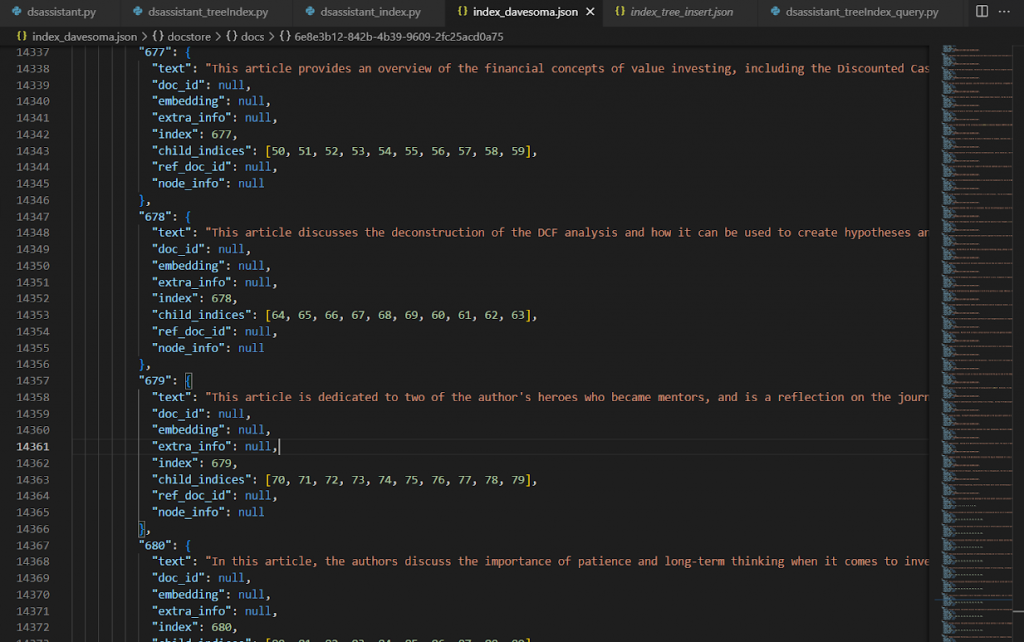
Fig. 6 indextree.json
This JSON file represents one interpretation of the data by the GPT_index library.
However, it is just one of the many ways to dissect the corpus, and there are options that are more or less efficient. In this case, the text is divided into pieces and each piece is given a distilled title that represents a series of children where the raw information to build the summary lies.
A complete string of the summary chatGPT extrapolate.
“This article is dedicated to two of the author’s heroes who became mentors, and is a reflection on the journey of investing. It is divided into three main categories: Temptations, Principles, and Cases Study. Temptations include psychological herd bias and market short-term attitude, which can lead to mistakes such as denial, anchoring, drift, and judging. Principles include life and investing, creativity and thinking, wisdom and self-learning, behavior value investing, portfolio management, global diversification, cash business valuation, and management valuation. Cases Study include Amazon, Costco, Dell, Walmart, and AirAsia. The article emphasizes the importance of patience, rationality, and discipline in investing, and warns against the dangers of bubble valuations and short-term thinking. It also encourages investors to look beyond the headlines and focus on the long-term potential of their investments.”
This is just one of the many nodes, and it mainly refers to this article (The Mentors: Nomad Letters Quote), which makes sense because it intuitively tends to group information from the same article that covers a specific topic.
There are also summaries that cross-reference different articles or tweets, which is truly interesting and something that can definitely be improved as a tool.
This is the result of a prompt where I asked for a distillation of the main notions. It is an incredibly well-made summary, a good condensed version, representing the essence of my blog, where it is possible to delve into with more specific prompts.
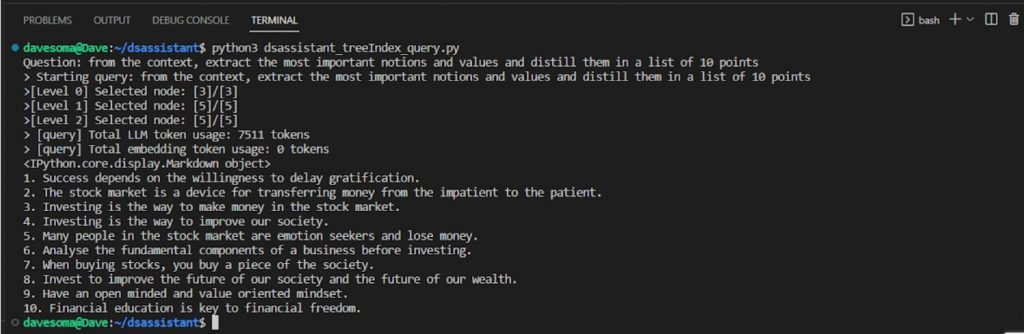
Fig. 7 A corpus of my blogs and tweets distilled into a series of principles, trivial but necessary to be remembered every day the stock market opens.
- Success depends on the willingness to delay gratification.
- The stock market is a device for transferring money from the impatient to the patient
- investing is the way to make money in the stock market.
- investing is the way to improve our society.
- Many people in the stock market are emotion seekers and lose money.
- Analyze the fundamental components of a business before investing.
- When buying stocks, you buy a piece of the society.
- Invest to improve the future of our society and the future of our wealth.
- Have an open minded and value oriented mindset.
- Financial education is key to financial freedom
Here, let’s delve into point 6.
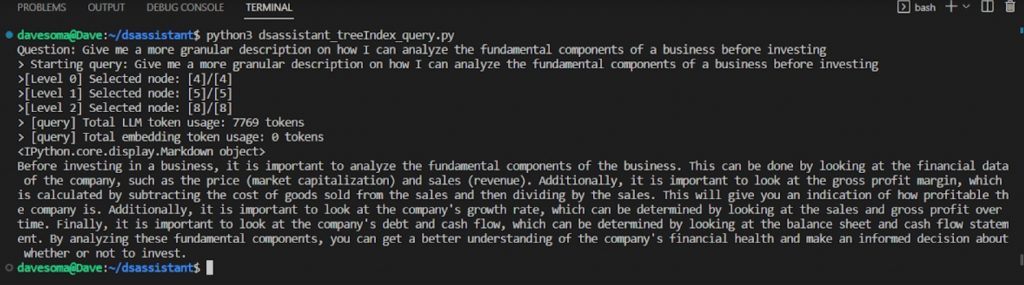
Fig. 8 more details
“Before investing in a business, it is important to analyze the fundamental components of the business. This can be done by looking at the financial data of the company, such as the price (market capitalization) and sales (revenue). Additionally, it is important to look at the gross profit margin, which is calculated by subtracting the cost of goods sold from the sales and then dividing by the sales. This will give you an indication of how profitable the company is. Additionally, it is important to look at the company’s growth rate, which can be determined by looking at the sales and gross profit over time. Finally, it is important to look at the company’s debt and cash flow, which can be determined by looking at the balance sheet and cash flow statement. By analyzing these fundamental components, you can get a better understanding of the company’s financial health and make an informed decision about whether or not to invest.”
It’s clearly possible to obtain more granularity, but you get the idea.
The index of my free course on value investing, Be Prepared
could be a good idea to take a glance at in relation to the well-expressed ideas of @ZANE presented here zaneausten.com
Tree-like thought.
One of the most important features of our brain is the ability to connect facts like a tree, branching out our thoughts as expressed by the visual representation of this library, we can now have help to reach some branches.
“Mental Super-Efficiency
https://www.ncbi.nlm.nih.gov/
The arborescent or tree-like thought structure [sound familiar? Tree index] allows them to quickly and unconsciously explore many lines of thought simultaneously and in parallel.”
Here, I’m attempting to link the first principle identified by OpenAI with the contents I provided, which pertains to the concept of dopamine in investing and nutrition. I aim to emphasize that seeking dopamine hits in investing, like in nutrition, never leads to long-term success.
What truly captivates me is the ability to extract universal principles from a diverse community, encompassing a range of perspectives and ethnicities.
Cultural Assets
Returning to our primary discussion, I have coined the term ‘Cultural Assets’ to emphasize the importance of expressing oneself through digital content. Such content can be utilized as inputs in a LLM or AI, resulting in becoming a cultural investor. In the future, it may be possible to credit the primary contributor for every ‘slice’ of this asset, possibly through an NFT linked to each message.
In other words, if we create these cultural supplements, it would be interesting to understand who participated and in what quantity in the production of them, identify the main contributor and give them credit, thereby structuring a better meritocratic system. If we can tokenize every message and article, it is not difficult to envision a future where those cultural recipes will contain the weight of every element, like a nutrition fact, which connects the idea to its creators and gives him royalties in the case of art intellectual properties.
I hope my article can spark new ideas and engage more individuals in this endeavor with the aim of streamlining our TNS community to be more efficient and competitive, providing its members with protection and a platform to express themselves to the fullest.
The effort of TNS to develop an internal culture for a healthy environment is the first step in building a network state.
Feel free to comment, share my article with friends and subscribe to my newsletter if you like my content and you want to follow me towards financial freedom.
You will obtain free access to my newsletter:
- Financial education
- A open minded and value oriented mindset
- Business and sector analysis
- A stoic and calm attitude towards the market ups and downs
No noise, only signal and high valuable contents
“Everything should be made as simple as possible, but not simpler.”
Albert Einstein
Free investing course index:
Disclaimer: The information contained on this website is for general information and educational purposes only. It is not intended as a substitute for legal, commercial and/or financial advice from a licensed professional.

Leave a Reply