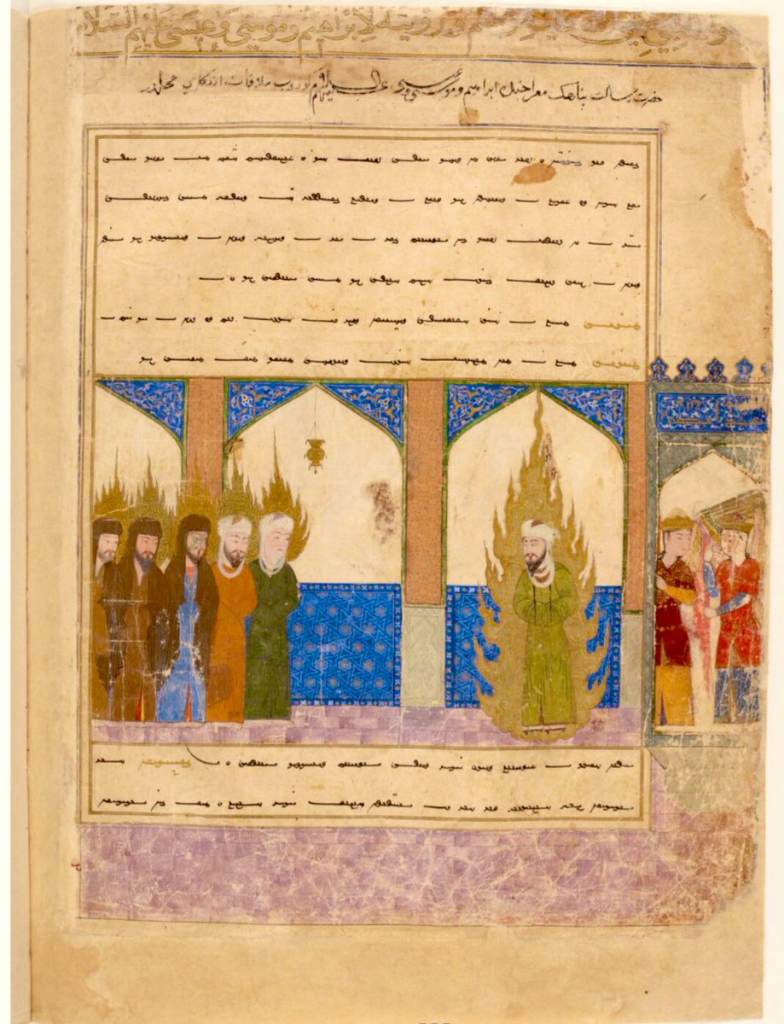
Persian miniature: The Giant ‘Uj and the Prophets Moses, Jesus and Muhammad
The Bible as a Rational Framework for Forecasting the Future
The Bible can be read as a compendium of patterns identified by prophets who were, in many ways, students of history. Rather than mystics lost in abstraction, they can be understood as observers of recurring cycles in human behavior and society. Over time, they distilled these patterns into narratives and teachings that were preserved in a single enduring text.
“Prophets are students of history.”
— davesoma
I spent many years in my adolescence studying the Bible. By nature, I am skeptical and rational, and I ask you to approach the following paragraphs in the same spirit.
It took me more than a decade, along with maturity and a multidisciplinary perspective, to realize that the Bible can be understood as a compendium of patterns. Its stories function as blueprints of human behavior in response to recurring events.
Events themselves tend to be cyclical, and these cycles are often captured effectively in biblical narratives.
Why is this important? Because if this interpretation holds, then the Bible becomes a distilled manual of how humans behave in different phases of a cycle, allowing us to anticipate what may come next.
I invite you to set aside your personal perspective on religion. Whether you are an atheist, a Christian, or follow Muhammad or Buddha, approach the Bible as a resource from which analytical tools can be extracted.
Humans tend to fall into biases and behavioral patterns (see my article on cognitive biases: my article on cognitive biases). History demonstrates this clearly. In Will Durant’s work on civilization, one can observe recurring cycles in which people interpret reality according to their position within those cycles. At the same time, these cycles are shaped by people themselves, creating self-reinforcing feedback loops that often begin and end in similar ways.
George Soros would describe this dynamic as reflexivity (my analysis of reflexivity).
“People” is a vague term. Each individual occupies a role within a broader structure. Most act as secondary participants, while some take a more active role. A smaller fraction, perhaps around ten percent, emerge as natural leaders who exert influence, though they too remain subject to underlying patterns.
If someone is able to recognize these patterns and, as the Bible suggests, “see the signs,” that recognition can create leverage. The ability to interpret events in ways others cannot often translates into popularity and influence. Throughout history, those who rise to prominence are frequently those who offer compelling interpretations of unfolding events.
Human tribes tend to gravitate toward individuals with specialized skills, one of which is the ability to identify patterns and leverage them effectively. When someone demonstrates this capacity to their peers, they often gain credibility and, over time, influence within the group. Historically, such influence has depended on a combination of cognitive ability and access to information that is not widely available, namely informational asymmetry.
“Then the king ordered Ashpenaz, chief of his court officials, to bring into the king’s service some of the Israelites from the royal family and the nobility— 4 young men without any physical defect, handsome, showing aptitude for every kind of learning, well informed, quick to understand, and qualified to serve in the king’s palace. “
Daniel 1:4
“Among those who were chosen were some from Judah: Daniel, Hananiah, Mishael and Azariah.”
Daniel 1:6
Imagine being the only person with normal visual acuity in a population of myopes. You would see farther and notice what others cannot. That is the metaphorical power attributed to prophets.
This stands in contrast to the common caricature of a prophet as a mystical figure wrapped in symbolism and folklore. A prophet may instead be understood as a rational, educated individual with unusual cognitive clarity.
Such a person does not predict the impossible; rather, they anticipate what is structurally likely. By acting on that anticipation, they may even reinforce the very outcome they foresee, thereby turning insight into influence.
Clearly, these individuals did not rely solely on their cognitive abilities. They also benefited from positioning themselves within institutions and gaining access to networks that amplified their influence. Luck, timing, and structural opportunity often played a role alongside intelligence.
One important aspect of forecasting the future is that it can merge into shaping the future. If someone identifies a force already in motion and holds a strategic position, they can influence the narrative and accelerate its direction.
Advancing within one’s environment, gathering resources, and reaching positions where influence is easier to exercise, while also being able to benefit from one’s own judgment, is itself a form of intelligence.
Voltaire is a notable example of an individual who shaped intellectual history through strategic positioning. By accumulating financial independence and social capital, he secured a platform from which his ideas could reach a wide audience. From that position, he influenced public discourse in ways that contributed to the intellectual climate preceding the French Revolution.
“Keep on hearing, but do not understand; keep on seeing, but do not perceive.”
— Isaiah 6:9–10
In biblical narratives, prophets often express frustration at what they describe as the inability of the broader population to perceive the signs they believe are evident.
“The prophecies are not given to make men prophets, but to make them believe the prophet when the time comes.”
— Isaac Newton, Observations upon the Prophecies of Daniel and the Apocalypse of St. John (1733)
It is therefore unsurprising that rulers throughout history have often aligned themselves with religious authorities, recognizing the legitimizing power of prophecy and belief.
Divided Empire.
Daniel was a Hebrew prophet and statesman exiled to Babylon in the 6th century BCE. Known for his wisdom and steadfast faith, he rose to prominence in a foreign court by interpreting dreams and visions that baffled kings. Despite political threats and religious persecution, he remained resolute, famously surviving the lions’ den.
Let us now examine what Daniel said about the succession of empires that would follow one another. In this passage, the prophet interprets the dream of King Nebuchadnezzar and provides an explanation of its symbolic meaning.
Daniel 2:31–45 (NIV):
31 “Your Majesty looked, and there before you stood a large statue—an enormous, dazzling statue, awesome in appearance.
32 The head of the statue was made of pure gold, its chest and arms of silver, its belly and thighs of bronze,
33 its legs of iron, its feet partly of iron and partly of baked clay.
34 While you were watching, a rock was cut out, but not by human hands. It struck the statue on its feet of iron and clay and smashed them.
35 Then the iron, the clay, the bronze, the silver and the gold were all broken to pieces and became like chaff on a threshing floor in the summer. The wind swept them away without leaving a trace. But the rock that struck the statue became a huge mountain and filled the whole earth.
36 “This was the dream, and now we will interpret it to the king.
37 Your Majesty, you are the king of kings. The God of heaven has given you dominion and power and might and glory; in your hands he has placed all mankind and the beasts of the field and the birds in the sky. Wherever they live, he has made you ruler over them all. You are that head of gold.
39 “After you, another kingdom will arise, inferior to yours. Next, a third kingdom, one of bronze, will rule over the whole earth.
40 Finally, there will be a fourth kingdom, strong as iron—for iron breaks and smashes everything—and as iron breaks things to pieces, so it will crush and break all the others.
41 Just as you saw that the feet and toes were partly of baked clay and partly of iron, so this will be a divided kingdom; yet it will have some of the strength of iron in it, even as you saw iron mixed with clay.
42–43 As the toes were partly iron and partly clay, so this kingdom will be partly strong and partly brittle. And just as you saw the iron mixed with baked clay, so the people will be a mixture and will not remain united, any more than iron mixes with clay.
44 “In the time of those kings, the God of heaven will set up a kingdom that will never be destroyed, nor will it be left to other people. It will crush all those kingdoms and bring them to an end, but it will itself endure forever.
45 This is the meaning of the vision of the rock cut out of a mountain, but not by human hands—a rock that broke the iron, the bronze, the clay, the silver and the gold to pieces. The great God has shown the king what will take place in the future. The dream is true and its interpretation is trustworthy.”
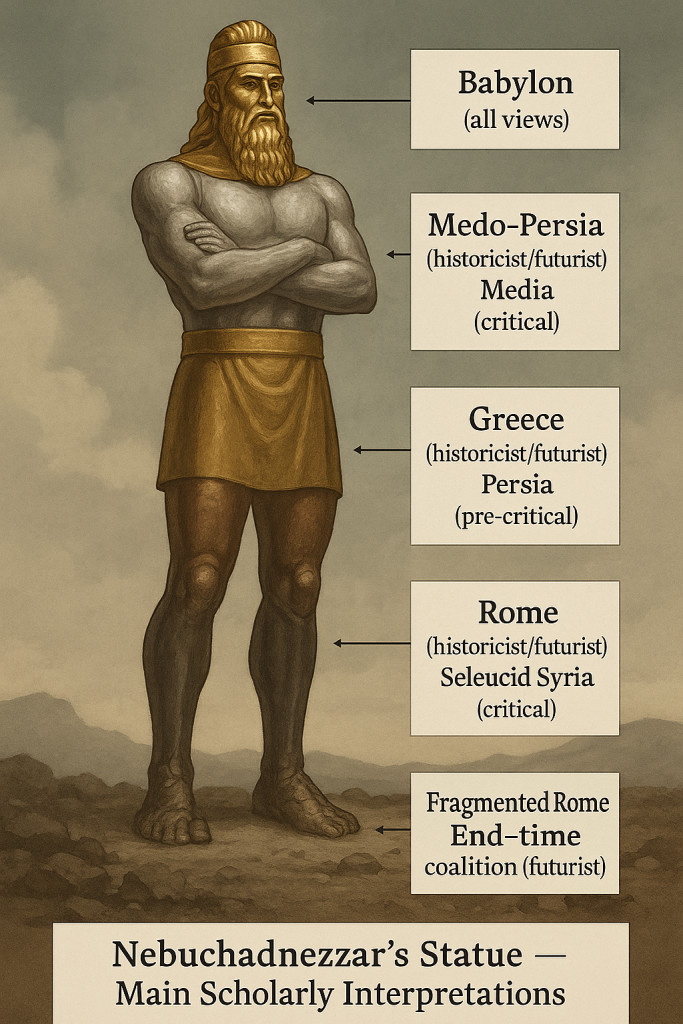
Daniel’s prophecy describes a succession of kingdoms. Interestingly, each kingdom, from the biblical perspective, appears more fragile than the one before it. The narrative conveys the idea of a single historical arc culminating in God’s judgment.
If we approach the text from a more skeptical perspective, we can interpret it differently. Rather than a single divine cycle, it may describe a recurring pattern in which successive empires become structurally weaker over time.
Perhaps the most intriguing element is the description of the final kingdom as internally inconsistent, unable to maintain cohesion. In the imagery of iron mixed with clay, the empire retains strength but lacks unity. This suggests a late phase in which instability arises less from external threats than from internal divisions within the society itself.
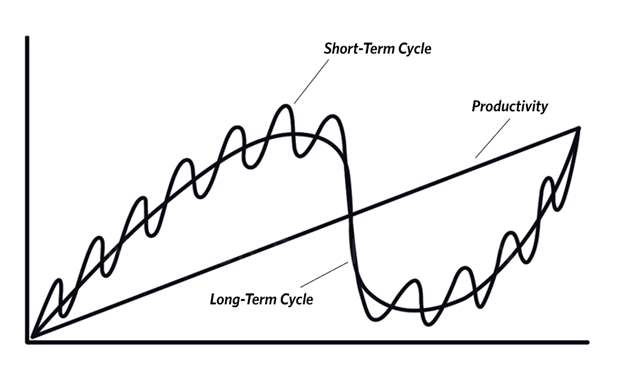
What if, in every cycle, we observe a similar dynamic repeating itself? These cycles may be shaped by forces that behave like a pendulum, swinging from one extreme to another and interacting reflexively with human nature, particularly our tendencies toward greed and fear. In that sense, understanding the future may sometimes require nothing more than studying the past through serious historical works rather than relying on simplified or sensationalized narratives.
“And just as you saw the iron mixed with baked clay, so the people will be a mixture and will not remain united, any more than iron mixes with clay.”
— Daniel 2:43
Polarization within the modern American empire appears to be increasing.
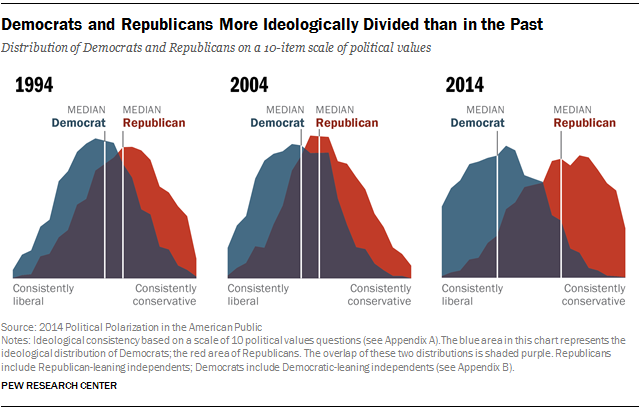
“so the people will be a mixture and will not remain united, any more than iron mixes with clay.”
Daniel 2:43
The current situation in the United Statess appears to resemble the landscape described by Daniel. Interestingly, similar conditions were also present during the later phases of the Roman Empire.
External pressures at the borders combined with growing internal divisions create a pattern that has appeared repeatedly in history. When referring to the “border” in this context, it can be understood more broadly as the frontier of the empire, which today is largely represented by the geopolitical perimeter of NATO.
“Above all, the same barbarians had already solicited to be admitted within the provinces of the empire; with outstretched arms and pathetic lamentations they loudly deplored their past misfortunes and their present danger, and most solemnly protested that, if the gracious liberality of the emperor would permit them to cultivate the waste lands of Thrace, they should ever hold themselves bound to obey the laws and to guard the limits of the republic.”
— Edward Gibbon, The History of the Decline and Fall of the Roman Empire, Volume I (1776)
It looks as if even in the behavior of these “migrants” little has changed. Their acceptance into the empire became one of the factors that contributed to Rome’s eventual decline, in a way resembling dynamics unfolding in the modern world today.
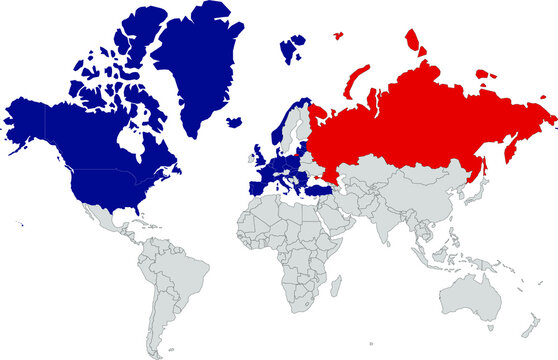
By the way, if you realize that the Bible reflects a Judaeo-Western perspective that captures recurring patterns in human behavior and in people’s often narrow perception of events, it becomes clear how powerful such a framework can be. By interpreting these patterns, one can position oneself as a prophet and gain credibility for seemingly foreseeing the future.
But what do other civilizations say about the same dynamics?
话说天下大势,分久必合,合久必分。
Romance of the Three Kingdoms (Luo Guanzhong, 14th c.)
“The empire, long divided, must unite; long united, must divide; this is how things have always been.”
It appears that different cultures and traditions have identified similar patterns. Once such a model is recognized, it becomes easier to interpret how events might evolve, and to frame those interpretations as prophecy or as the result of divine inspiration.
Key points:
Cyclical patterns in the rise and decline of civilizations
Internal division as a characteristic of the final phase
Leadership
“For the time is coming when people will not endure sound teaching, but having itching ears they will accumulate teachers to suit their own desires, and will turn away from the truth and wander into myths.”
— 2 Timothy 4:3–4
In this passage, the reader is warned that in the later stages of a cycle people may become less willing to engage with difficult truths and more inclined to follow voices that simply confirm their desires. In such an environment, leadership tends to shift toward the most populist figures rather than those offering the most rigorous or uncomfortable insights.
Peace
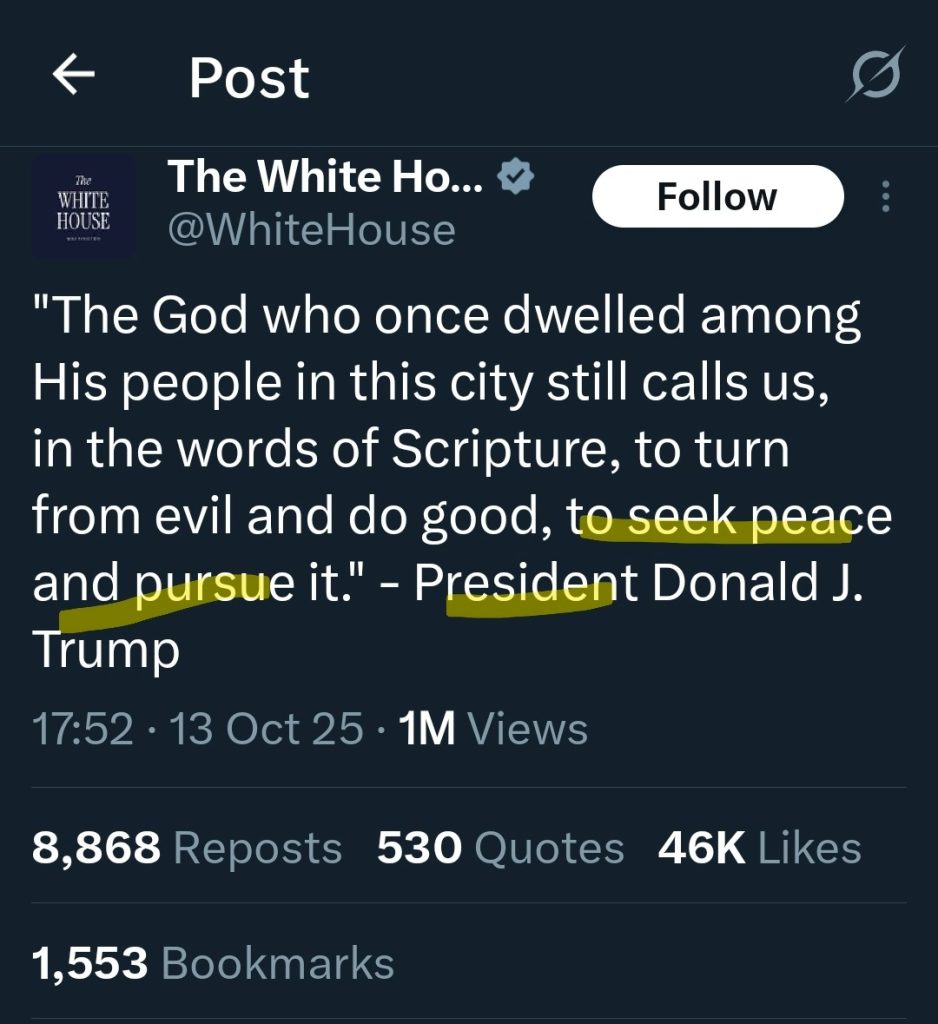
A similar theme appears in another set of passages, where leaders in the final stages of a cycle are criticized for offering reassurance rather than confronting underlying problems.
“For when they say, ‘Peace and safety!’ then sudden destruction comes upon them, as labor pains upon a pregnant woman, and they shall not escape.”
— 1 Thessalonians 5:3
“They have healed the wound of my people lightly, saying, ‘Peace, peace,’ when there is no peace.”
— Jeremiah 6:14
In these passages, the declaration of peace by leaders is portrayed not as genuine stability but as a form of reassurance masking deeper instability. A similar dynamic can sometimes be observed in modern political communication, where maintaining public calm becomes a priority even when structural tensions remain unresolved.
It resembles a pilot reassuring passengers that everything is under control while turbulence intensifies outside the cabin.
Cope
“You know why they put oxygen masks on planes? Oxygen gets you high. In a catastrophic emergency, you’re taking giant panicked breaths… Suddenly you become euphoric, docile. You accept your fate. It’s all part of the illusion of safety.”
— Tyler Durden, Fight Club
Interestingly, comparable warnings appear in other cultural traditions.
“When they are told, ‘Do not spread corruption on the earth,’ they say, ‘We are only peacemakers.’ Indeed, they are the corrupters…”
— Qur’an 2:11–12
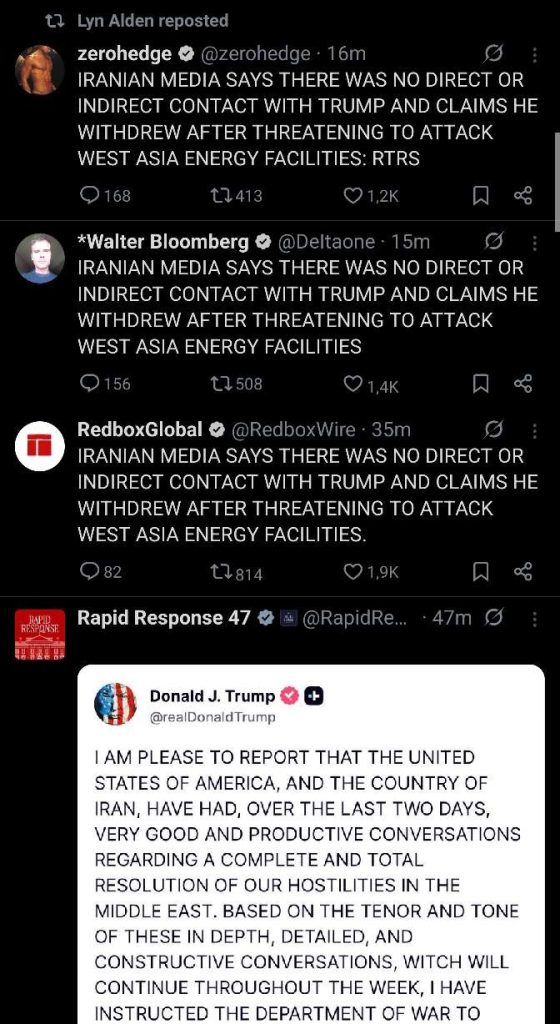
Key point:
Reassurance from politicians combined with the ruling class’s inability or unwillingness to fix a broken system.
They manipulate the masses and shape their public image through language that resonates with the population. Yet words remain only words, and the underlying objective is often the preservation of power by maintaining control over the broader public.
RaaS (Religion as a Service)
Religion can be understood as a kind of service layer for social coordination, a framework that organizes belief, identity, and collective action. Seen from this perspective, the resemblance between religion and certain modern ideological movements becomes less surprising.
Why is this interesting from a prophetic standpoint? Because political power has often intertwined with religion to gain traction over a deeply rooted human tendency: the inclination to gather under the banner of a higher ideological authority.
“So the king took counsel and made two calves of gold. And he said… ‘Behold your gods, O Israel’… and he set one in Bethel, and the other he put in Dan.”
— 1 Kings 12:28–30
I wrote an article describing Bitcoin as a religion because, in my view, it shares many structural features with religion (link to the article). In this sense,
“Never sell your Bitcoin.”
— Donald Trump, Bitcoin Conference 2024
I believe the phenomenon of religion tends to strengthen during periods of instability. Competing belief systems emerge alongside the incumbent one, gradually challenging or replacing the prevailing “religion” of the time.
Religion is a topic I reflected on deeply during my youth. Reading historians such as Will Durant helped shape many of these intuitions.
We have already seen the biblical warning that, in later stages of a cycle, people may become more inclined toward myths. One can observe a similar dynamic today in the simultaneous revival of ancient creeds alongside the emergence of new ideological belief systems.
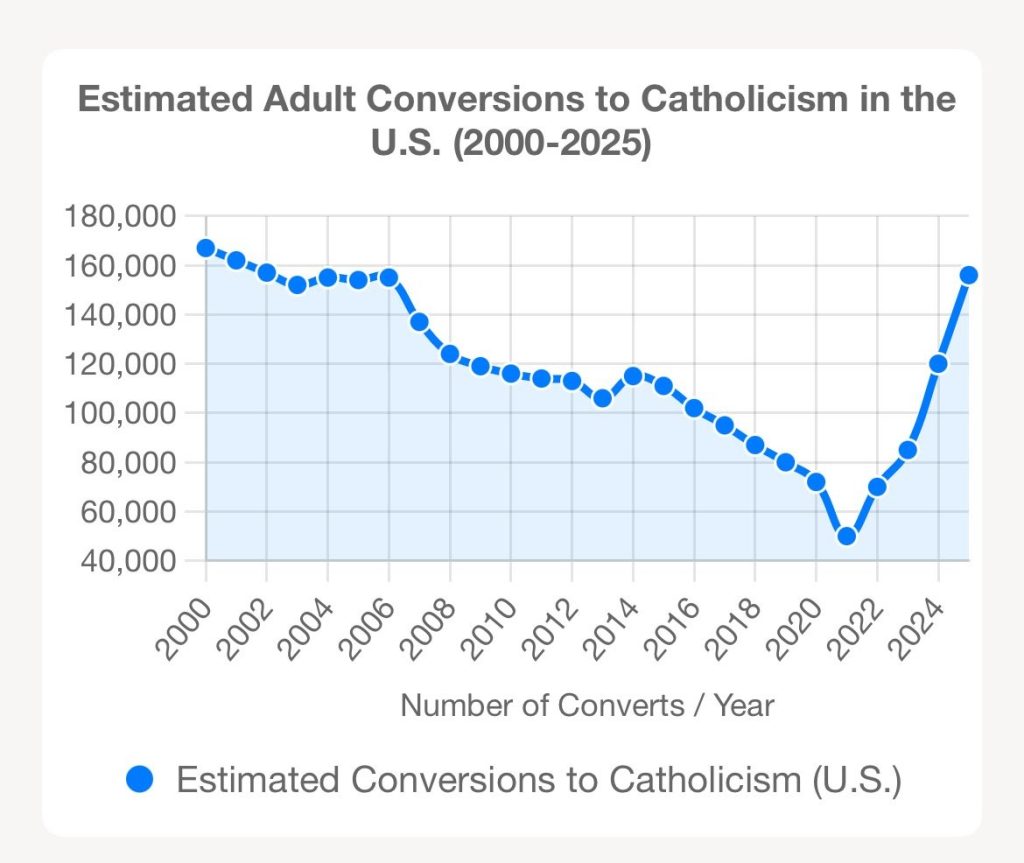
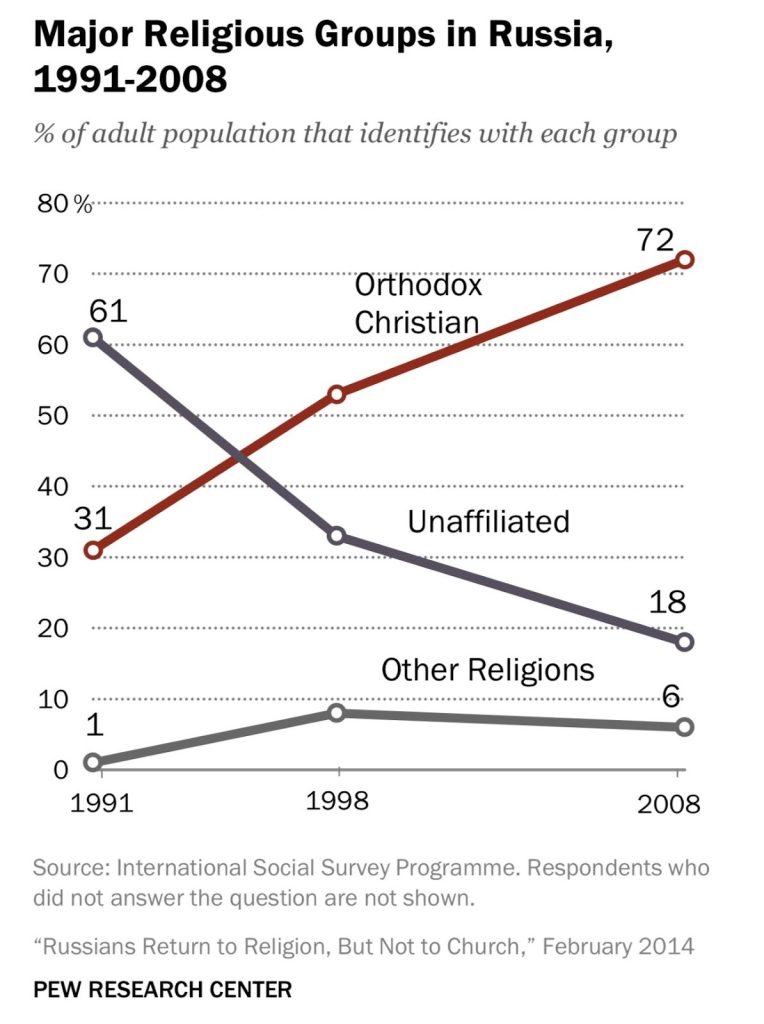
In 1991, the Soviet Union collapsed, and the collapse appears to have paved the way for a revival of religious belief. The sudden growth of religious institutions and participation in the post-Soviet world can be seen as another example of how belief systems tend to re-emerge during periods of institutional vacuum and social uncertainty.
Religion has many functions: it gives consolation to the poor, hope to the defeated, and courage to the oppressed.
Will Durant
Rome
“He came to look upon the Catholic Church as the most effective instrument ever devised for the control of men and women, for their grumbling or silent habituation to economic, social, and sexual inequality, and for their public obedience to divine commandments uncongenial to human flesh. If there could not be a policeman at every corner, there could be gods, all the more awesome because unseen, and multipliable at will and need into mystic beings, hortatory or minatory, ranged through grades of divinity and power from the desert anchorite to the ultimate commander, preserver and destroyer of stars and men. What a sublime conception, what an incomparable organization for its dissemination and operation, what a priceless support for teachers, husbands, parents, hierarchs, and kings! Napoleon concluded that the chaos and violence of the Revolution had been due, above all, to its repudiation of the Church. He resolved to restore the association of Church and state as soon as he could take the fangs out of horrified Jacobins and mortified philosophers.”
Will Durant
It is interesting to consider the case of Napoleon. After seizing power and eventually crowning himself emperor, he chose to restore space for religion. This is striking because one of the forces that had helped destabilize the old order was precisely the weakening of the Church. Yet Napoleon, as a rational and power-conscious statesman, understood something many rulers before him had also understood: the power of a man as a mere physical entity is limited, whereas the power of an idea, especially the idea of a God who sees all and judges all, can reach far deeper into society.
“So, as soon as I had power, I … reestablished religion. I made it the groundwork and foundation upon which I built. I considered it as the support of sound principles and good morality.”
Napoleon
He tried to reassure skeptics by explaining that he would make the Church an instrument of government for the preservation of internal peace. Even so, many feared that this move was another step in the retreat from revolution toward monarchy.
Even today, power structures often intertwine with both old and new forms of belief in order to maintain influence over the population. Narratives are amplified through media ecosystems, where influencers, coordinated messaging, and automated accounts on platforms such as Twitter or Reddit can all contribute to shaping public perception.
Inflation
See how the faithful city
has become a prostitute!
She once was full of justice;
righteousness used to dwell in her—
but now murderers!
22
Your silver has become dross,
your choice wine is diluted with water.
23
Your rulers are rebels,
partners with thieves;
they all love bribes
and chase after gifts.
They do not defend the cause of the fatherless;
the widow’s case does not come before them.
— Isaiah 1:21–23
Interestingly, the passage almost sounds as though it is describing shrinkflation, especially in its reference to wine being diluted.
“Shrinkflation is the practice by which a product’s size or quantity is reduced while its price remains the same or increases slightly. Essentially, it is a way for companies to manage costs or increase profits without directly raising prices, and it often occurs during periods of inflation or rising production costs.”
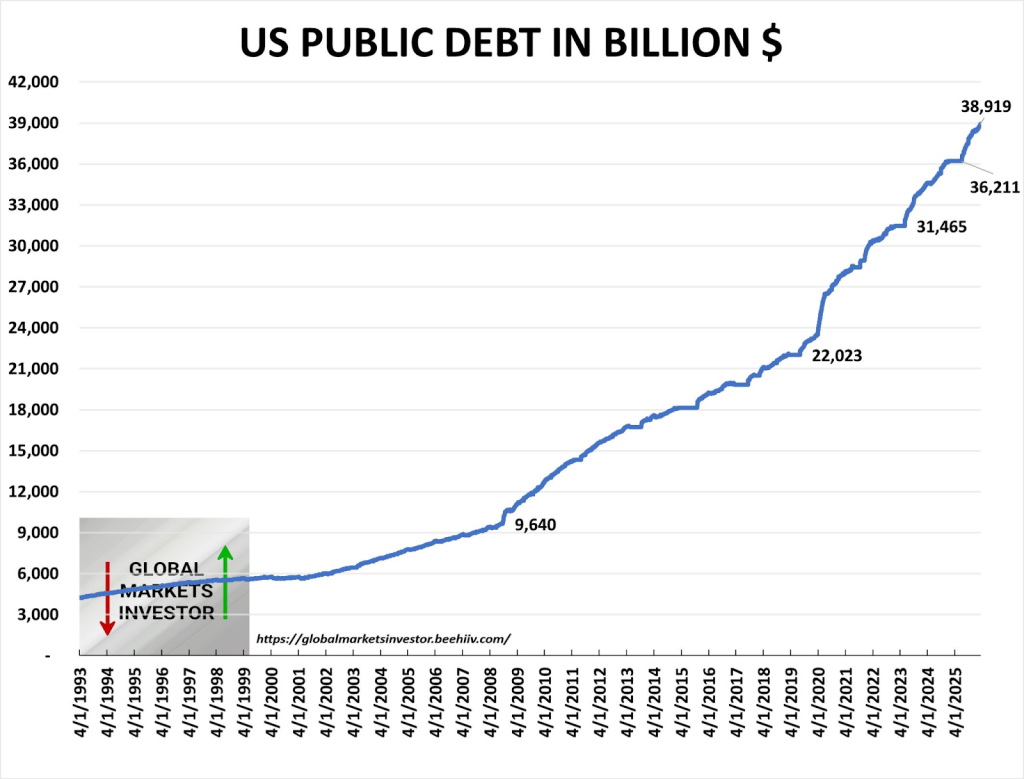
A practice that seems to have been present in many other moments of human history, and one that the Bible captured as an important phenomenon to describe and crystallize as a lesson for posterity. Why is this interesting? Because it points again to the end of the cycle, a phase usually characterized by currency devaluation, as we see today, and by rising indebtedness at both the government and household levels. Reducing quantity while maintaining the same price is a trick similar to inflation itself, only more concealed.
This is another piece of the puzzle when speaking about Bible as a blueprint indeed where inflation or shrinkflation is a symptom we have also a description of the cause:
Deuteronomy 28:36–44
36 The Lord will drive you and the king you set over you to a nation unknown to you or your ancestors. There you will worship other gods, gods of wood and stone. 37 You will become a thing of horror, a byword and an object of ridicule among all the peoples where the Lord will drive you.
38 You will sow much seed in the field but you will harvest little, because locusts will devour it. 39 You will plant vineyards and cultivate them but you will not drink the wine or gather the grapes, because worms will eat them. 40 You will have olive trees throughout your country but you will not use the oil, because the olives will drop off. 41 You will have sons and daughters but you will not keep them, because they will go into captivity. 42 Swarms of locusts will take over all your trees and the crops of your land.
43 The foreigners who reside among you will rise above you higher and higher, but you will sink lower and lower. 44 They will lend to you, but you will not lend to them. They will be the head, but you will be the tail.
The theme of this block is:
national decline
foreign domination
loss of sovereignty
economic reversal
humiliation
Noah and Lot
A notable pattern highlighted in the Bible was later recognized in psychology as a cognitive bias: normalcy bias. When conditions begin to change rapidly, people tend to assume that life will continue as usual. Acting decisively requires breaking from routine, yet most individuals continue behaving as they always have.
1. The Flood (Noah)
Warning: “Noah, a preacher of righteousness” (2 Peter 2:5)
Warning: “By faith Noah… warned by God concerning events as yet unseen” (Hebrews 11:7)
Reaction: “They were eating and drinking, marrying… until the day Noah entered the ark” (Luke 17:27)
2. Sodom & Gomorrah (Lot)
Warning: “Lot went out and said to his sons-in-law… ‘Up! Get out of this place…’ But he seemed to his sons-in-law to be jesting” (Genesis 19:14)
Reaction: “They were eating and drinking, buying and selling… until the day when Lot went out from Sodom” (Luke 17:28–29)
Outcome: “The LORD rained on Sodom and Gomorrah sulfur and fire… But Lot’s wife… looked back” (Genesis 19:24–26)
These narratives illustrate a recurring dynamic: warnings are issued, but most people dismiss them and continue with their routines until the consequences become unavoidable.
Titanic, a modern example
Many eyewitnesses reported that, in the first minutes after the Titanic struck the iceberg, passengers showed “no apprehension of any danger” and “no… panic or hysteria,” as survivor Lawrence Beesley recalled. Colonel Archibald Gracie similarly noted “no hysterical cry, no evidence of panic,” and Walter Lord later described people calmly resuming their routines, “almost as if nothing had happened.”
Early lifeboats were even launched half empty, as many hesitated to abandon what still appeared to be a solid and safe ship. This behavior aligns with later research on maritime disasters, which shows that social norms, such as “women and children first,” and reluctance to act can significantly influence survival outcomes.
Psychologists refer to this inertia as normalcy bias: the tendency to underestimate both the likelihood and the severity of a crisis, and to behave as though life will continue as usual. Viewed through this lens, the behavior observed on the Titanic helps explain why so many people remained in place until the danger became undeniable.
King of the North and King of the South
The Bible presents the King of the North and the King of the South as two rival powers locked in a recurring conflict across generations. In Daniel, rulers change, but the pattern remains the same: war, deceit, false negotiation, conquest, and desolation. Even when they sit at one table, they tell lies, showing that the struggle is not only military but also political and psychological. Through a rational lens, this prophecy can be read as both a historical vision and a recurring pattern in the rise and decline of civilizations. For religious readers, however, it may also be seen as a sign of the approaching end, the fulfilment of the prophecy and the confirmation of the divine power of the prophet and the king.
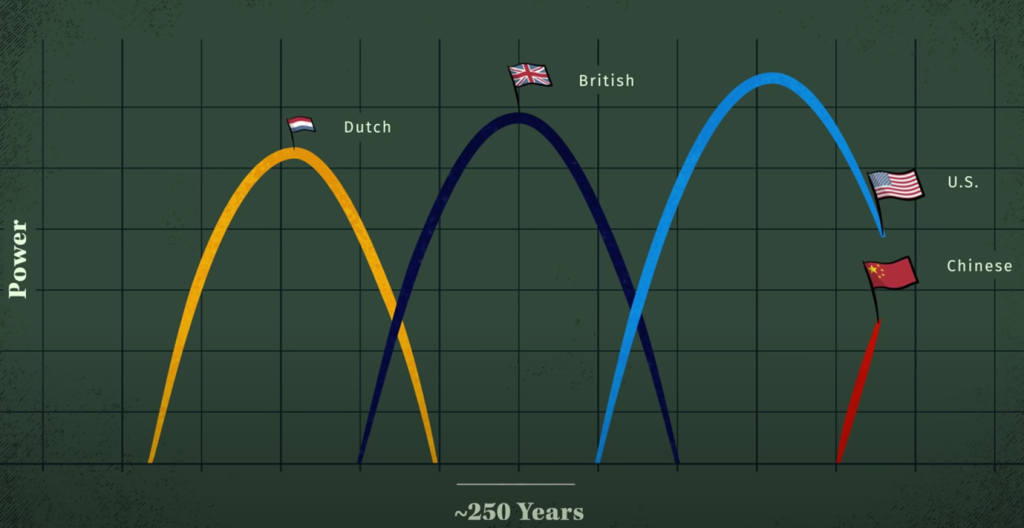
This is a recurring pattern in history: rival powers compete, war and technology intensify, and humanity is transformed in the process. The conflict between the King of the North and the King of the South may generate progress and enrich civilization, but it does not bring a final end. Rather, periods of peace under a dominant power produce stability, then complacency; complacency creates the conditions for a rising rival, and that rival brings chaos, a new order, and the emergence of great leaders and rare genius.
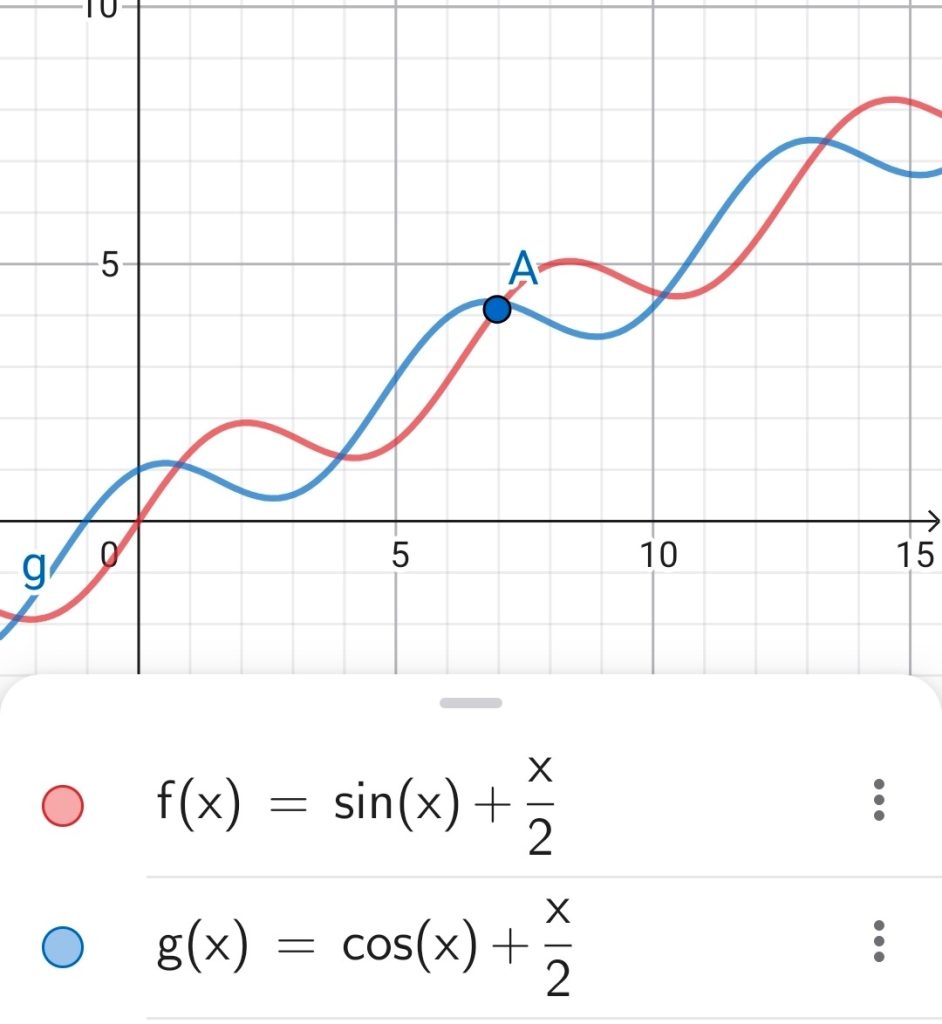
So the upward trend emerges because conflict forces human societies to invent, adapt, and evolve under pressure from competition for scarce resources.
Apocalypse as a Recurring Interpretation
Will there be an apocalypse? In historical terms, there is always an apocalypse, or at least the perception of one.
“‘When the black swarm of Hungarians first hung over Europe, about nine hundred years after the Christian era, they were mistaken by fear and superstition for the Gog and Magog of the Scriptures, the signs and forerunners of the end of the world.”
— Edward Gibbon, The History of the Decline and Fall of the Roman Empire (1776)
Gibbon is referring to the first major Magyar incursions into Western and Central Europe in the late ninth century, beginning around 895 AD. Contemporary chroniclers, struggling to classify this new threat, interpreted it through familiar biblical imagery and identified the invaders with Gog and Magog from Ezekiel 38–39 and Revelation 20.
“When the thousand years are over, Satan will be released from his prison and will go out to deceive the nations in the four corners of the earth—Gog and Magog—and to gather them for battle.”
— Revelation 20:7
This illustrates a recurring pattern: when societies face unfamiliar threats, they interpret them through existing symbolic frameworks. In this sense, the Bible provides a narrative structure that allows individuals to situate themselves within a broader and more meaningful story.
The strength of the Bible as a sacred text lies in its ability to construct a cyclical blueprint and place the observer at its center. Each individual can interpret events as part of a larger narrative, in which separating oneself from the masses and adhering to a defined path offers the promise of meaning and reward.
Signs of the end: intergenerational breakdown
What is your personal perception of today’s youth?
That is what happened in the final phase of the French Revolution, before Napoleon took over and reestablished order.
“Anne Plumptre, who traveled in France in 1802, reported a gardener as telling her: ‘During the Revolution we dared not scold our children for their faults. Those who called themselves patriots regarded it as against the fundamental principles of liberty to correct children. This made them so unruly that very often, when a parent presumed to scold his child, the latter would tell him to mind his own business, adding, “We are free and equal; the Republic is our only father, and no other.” … It will take a good many years to bring them back to minding.’”
— Will Durant
Ammianus Marcellinus:
“The people are devoted to luxury… the young are given over to frivolity and excess.”
So, what does the Bible say about the last days before God takes over?
“But mark this: There will be terrible times in the last days…
People will be… disobedient to their parents…”
— 2 Timothy 3:1-2
“I will make mere youths their officials; children will rule over them.
People will oppress each other… the young will rise up against the old.”
— Isaiah 3:4-5
“For son dishonors father, daughter rises against mother… a man’s enemies are the members of his own household.”
— Micah 7:6
Here again, these signs of the end tend to repeat in one way or another, because these patterns recur throughout history.
Destruction is healthy.
“When the world experiences a complete overturn, it seems to change its nature in order to permit new creation and a new organization. Hence there is a need today for a historian who can describe the state of the world, of its countries and peoples, and indicate the changes in customs and beliefs.”
Will Durant, The Reformation (Volume VI of The Story of Civilization)
This echoes the spirit of Ibn Khaldūn, the 14th-century North African historian and philosopher who, in his Muqaddimah, pioneered the idea that history is not merely a record of events, but a science of civilizations, their rise, decay, and renewal. In times of great upheaval, it is precisely such a historian that the world requires, one who understands the underlying forces shaping human society.
Always remember that the most important and meaningful future of our species lies in the ability to create knowledge, and that a single shard of knowledge can completely change the course of history. Crisis is the mother of evolution and change for the better.
“The ability to create and use explanatory knowledge gives people a power to transform nature which is ultimately not limited by parochial factors, as all other adaptations are, but only by universal laws. This is the cosmic significance of explanatory knowledge, and hence of people, whom I shall henceforward define as entities that can create explanatory knowledge.”
David Deutsch, The Beginning of Infinity: Explanations That Transform the World
“One thing that all conceptions of the Enlightenment agree on is that it was a rebellion, and specifically a rebellion against authority in regard to knowledge.”
David Deutsch, The Beginning of Infinity: Explanations That Transform the World
Times of crisis are always times of change in governance. The incumbent power becomes divided and fragile, and a new power arises to conquer the space left free by the old one. It almost always starts with a rebellion.
Does this mean that rebellions are driven by virtue, that the next subversion of the equilibrium will be for the good, as the Bible points out? No, because the Bible places everything in a dichotomy of good and evil, and in that way it becomes easy to define moral rules and an enemy to blame. In reality, there is only power, and power defines who is good and who is evil, or what is good and what is evil.
Rebellions are the raw force that subverts the incumbent in favor of the newcomer, the old in favor of the young and the fit. Neither nature, nor natural cycles, nor virtue determines leadership. The one who is smartest and most able to outfox the masses is the one who will take it.
“Adversity reveals genius, prosperity conceals it.”
Horace
What about the rest of the world?
When we analyze a situation, we often fall into the trap of believing that we represent the world, or that the world somehow revolves around us.
Decline is real, but it is not necessarily universal. Events unfold differently across societies and are largely shaped by productivity and economic conditions. I was recently in China, and I can say that I saw a population living through an uptrend by many measures, something reflected in a friendly and welcoming attitude.
I realized that many behaviors, both in real life and on social media, are the product of a toxic environment whose causes are often rooted in the phase of the cycle we are living through.
In this article, I analyze these cycles through the lens of ancient prophets, and I also recount the experience I had in China.
What, then, should we do? I think the best response is to be prepared. Preparation means financial stability and the courage to explore the world. Perhaps then you realize that it is not wealth itself that improves an environment, but the shared perception of living in an uptrend, a phase of the cycle in which people see the results of their efforts, cooperate, and reap the fruits of what they have built together.
Subscribe to my newsletter
Subscribe for free to get:
- Financial education
- An open-minded and value-oriented mindset
- Business and sector analysis
- A stoic and calm attitude towards the market ups and downs
Leave a Reply