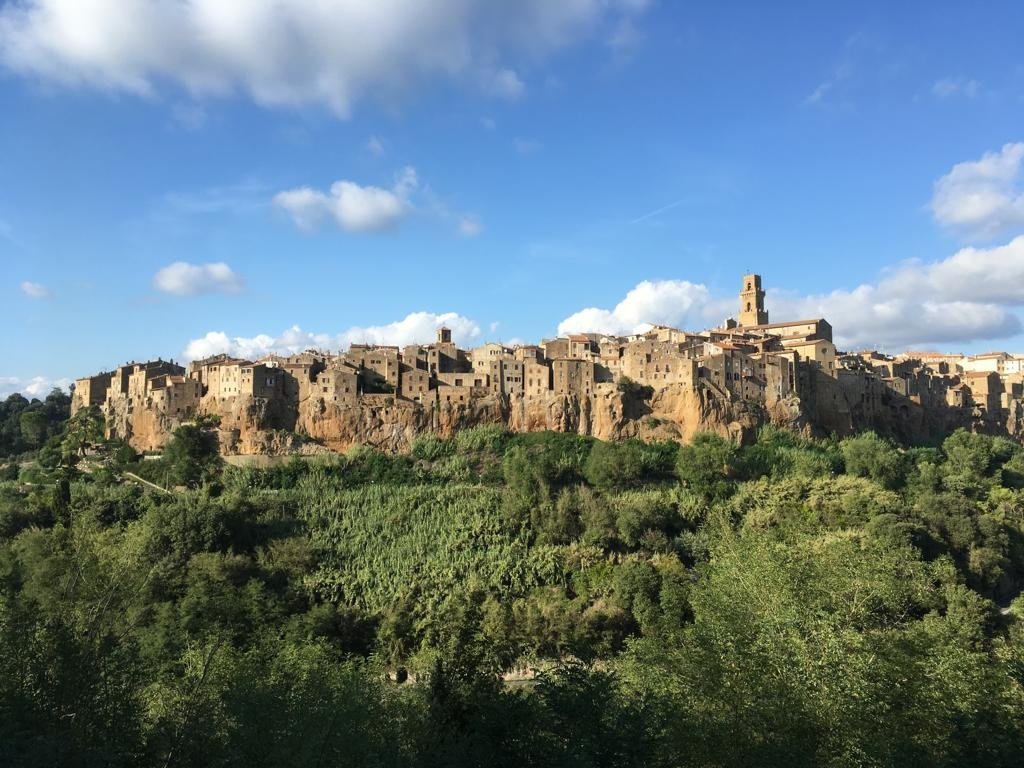
Photographer: Jenny
“In business, I look for economic castles protected by unbreachable moats”
Warren Buffett
Capitalism is like life, it is a war.
Our goal is to find the best fortress where to put our capital, ideally a fortress with a wide moat, and a smart and powerful lord.
In the course of human history, battlegrounds have changed but not the nature of humans, we can’t neglect our nature, we are born to fight because throughout the fight we built a better and enhanced society. This is exactly the purpose of capitalism, and we are all involved in this mechanics.
It’s possible to simply become lazy and stop fighting, typically that happens at the peak of a civilization (i.e US trade deficit). Then another civilization takes over, and lets the old one die.
Look around you, most of the western products, brands, lands are now owned by asian and developing countries. Why does this happen? Because they want to fight. (e.g. 100% Volvo and 10% Mercedes-Benz owned by Geely (China), lands and buildings in Milan – COIMA RES owned by Qatar, …).
How do we fight in this new world? We have to learn to adapt. In other words: stop scrolling social media like zombies, bring a book and start reading and develop new skills (shields and swords).
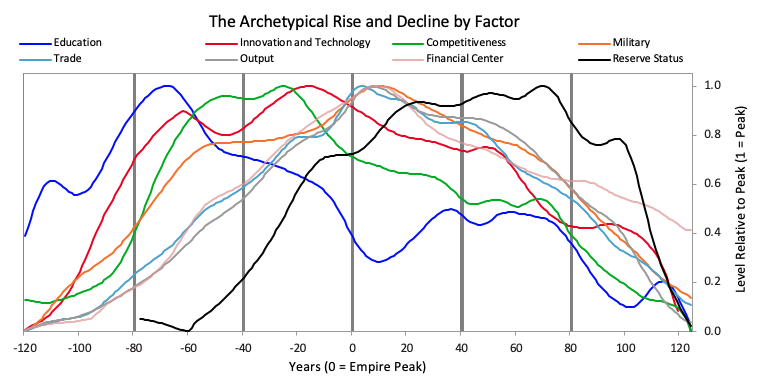
Note that: education is the first signal of decline, followed by competitiveness.
“In effect, we know from Darwin that there are only four characteristics necessary in order to get adaptive evolution, right? If you have reproduction, variation, differential success, and an environment of limited resources, you’re going to get adaptive evolution. When we set up an economic system, or a political system…*it evolves*. Things evolve within it.”
Bret Weinstein, Biologist, PhD
Why we fight?
We fight because our planet has limited resources, and we need to use them efficiently, this is the only way to survive as human beings. We have to destroy what doesn’t work anymore to build what will work better and efficiently. (E.g., renewable energy are going to destroy oil/gas, e-commerce vs brick and mortar, cryptocurrencies vs FIAT currencies, AI/blockchain/data are going to automatize bureaucracy and will free our species from the burden of bureaucracy/routine works in order to free our limited time and unleash our creativity.) Imagine a future world, with 30 billion people, where we will occupe thousands of surface meters to allocate gigantic off-line malls. Doesn’t seem an efficient way to occupy the limited space of our planet, it seems better to have an efficient warehouse coordinated by robots with a virtual showcase ($AMZN) in a metaverse (SEHK700) where we can walk around thanks to virtual reality ($FB). That could permit free space for gigantic woods and parks in the real world. Maybe once there was a desert, now it was a forest. Maybe Thanks to a startup like Solar Water, where you have invested, that uses solar energy to power a desalination plant).
Then stop complaining about the fact you are going to lose your job because of automation. You will lose it, it’s unavoidable. Learn to adapt!
Worry about an algorithm will substitute your work? Find the MOAT company, maybe a SaaS, save and invest in the company that develops this product, and gain from the future dividends and buybacks, buy it a fair price! (7. How the companies reward us). If you work well at the end you will retire from work and start doing whatever you want.
Who will be the final opponent?
Probably AI, I think automatization and algorithmes are going to push our species to the next level (or maybe singularity? Checkmate :P).
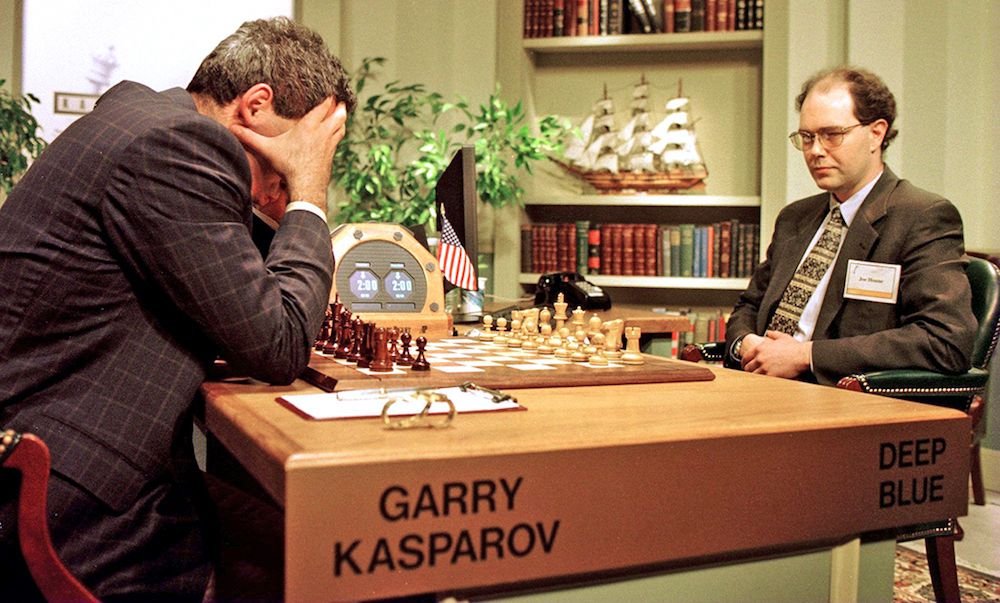
“AI ever allows us to truly understand ourselves, it will not be because these algorithms captured the mechanical essence of the human mind. It will be because they liberated us to forget about optimizations and to instead focus on what truly makes us human: loving and being loved.”
Kai-Fu Lee, PhD, Computer Science Mellon University
(Guess who is strongly competing to develop the best AI infrastructure? China.)
But for now, in order to evolve, is our responsibility (extinction is the alternative) to correctly allocate the limited resources available, thus we have to find a good Lord that will do this work for us.
Indeed, the most important characteristic of a lord is exactly related to his ability in the capital allocation in order to expand the village, defend it, and make the best use of the available resources.
Remember the notion of capital allocation, because we are going to talk about it in the next articles.
Now the castle is named corporation and the lord is named CEO, but there is always a war to fight.
As shareholders we are kings, and we need to preserve our wealth from the attacks of the enemies.
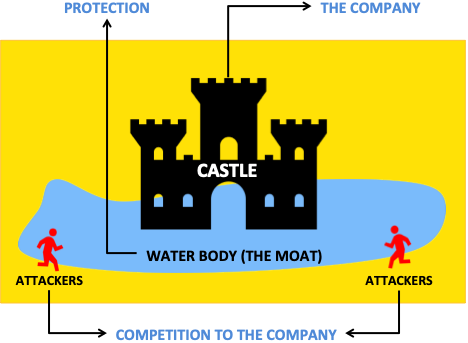
source: getmoneyrich.com
Why do I tell you this story?
Because in next articles we are going to find the characteristics of a good castle and dig deeper about the qualities of a good lord, and how a good moat is built.
Eventually the moat reassures us, if business has an advantage over the competitors, this advantage increases the reliability of our forecast about future cash generated by our company. Over the long run many competitors are going to try to take a piece of the pie (i.e., users, customers, revenue, cash flow). We need to defend our wealth.
In the future we are going to talk also about, like a king, how much lands you need in order to increase your wealth (portfolio).
“Equity is the new land. Shareholder is the new landowner”
Naval Ravikant
Economic MOAT

In 1980 the academic Michael Porter wrote the book “Competitive Strategy: Techniques for Analyzing Industries and Competitors”. In this book Porter described the five main forces which protect the profitability of a business.
Fig. 5 Porter’s 5 forces
“Incidentally, that’s one of the things we look for in businesses; if you see a business take a lot of adversity and still do well, that tells you something about the underlying strength of the business… a way of evaluating the depth and impenetrability of the moat.”
Warren Buffett
Financial moat gives us more certainty about future cash flow, reducing the intrinsic uncertainty of the humans’ world. As you can see in figure 5 this moat could has various forms, in this blog we are going to dig the qualitative and quantitative characteristics of some of this moat
Then when I will tell you about moat, you will know my purpose.
During this blog we are going to develop a series of mental models that give us a better understanding of our world. Biology and evolution are two of these models, and history is another one. In the past, I had already written about psychology (8. Mr. Market). Those concepts mix together give us the basis of our mindset as investors for the long haul.
“Developing the habit of mastering the multiple models which underlie reality is the best thing you can do”
Charlie Munger
(ELI5 mental models: a series of tools or ideas brought from the hard or soft science and applied to a complex argument, typically finance because of his complex and adaptive nature).
Learn, train, take risks. In other words, fight!
In this sense my blog’s goal is to become your intellectual trainer and sparring partner.
Following chapter 15. Income statement analysis
Feel free to comment, share my article with friends and subscribe to my newsletter if you like my content and you want to follow me towards financial freedom.
You will obtain free access to my newsletter:
- Financial education
- A open minded and value oriented mindset
- Business and sector analysis
- A stoic and calm attitude towards the market ups and downs
No noise, only signal and high valuable contents
“Everything should be made as simple as possible, but not simpler.”
Albert Einstein
Leave a Reply