
Why a lemon drink and a paradisiac beach?
Because at the end of this journey, we will meet together on an exotic beach as digital nomads, enjoying the dividends of our companies.
Am I joking?
Every great adventure contains a treasure to discover, risks, and a good dose of uncertainty. I cannot tell you the outcome, indeed the thrill you will feel is named uncertainty.
By the way, the lemonade metaphor will be more clear during the reading of the article.
Enjoy the next step of our adventure…
What are we going to learn?
- The logic behind the price
- The formula of intrinsic value
- The convergence between value and price
Here we are, it’s time to take all the knowledge we have digested until now (Blog Index), and put it to work to define a price.
Even if nowadays, the price seems a secondary feature with respect to the decision of buying a security, it’s always been and it always will be the crux of the matter. At the end of the day, it’s always a question of price. At the right price every asset could be a buy.
I tend to agree with the last years of the investing practice of Buffett:
“It’s far better to buy a wonderful company at a fair price than a fair company at a wonderful price.”
Warren Buffett
This is because at the start of his career Buffett followed the preach of his teacher Graham, which developed his reasoning during the ‘29 crisis, and he was focused on companies discounted in respect of their tangible assets. Sometimes even defined by Graham as “cigar butt”, heavily discounted companies in regard to their tangible assets at the point that the value of the assets itself was greater than the price of the security. Then in a liquidation event (bankruptcy), the investor would have received back the proceeds of the fire sale (only after bondholders).
Today, especially in the developed market, we rely on services and technologies which are asset-light businesses.
What does the switch from asset heavy to asset light means?
Book value (the value of the assets found on the balance sheet) are less valuable in respect to the past.
Today we have companies with a high barrier to entry, a powerful brand with mindshare and strong network effects, which produce high profit with less assets. Think about that, if I have a strong intellectual property as a new superhero character named DScompounding, if this superhero has a digital platform of distribution with network effect (e.g. Netflix) with the superpower of the “compounding effect”, it can replicate itself over the planet through every device of the Netflix network, as for example your phone, the phone of your friends. But what is the cost of the product?
There is a cost of related to the character creation, its advertisement, and the cost of technically realizing the platform of distribution, but today with cloud this costs can be minimized and, if I can reach scale with my platform, the cost of another copy of my movie with Dscompounding Superhero will be approximately ZERO, this give me earnings power even if I can maintain a low price because the cost of distribution is low.
In other words, our world becomes less Atoms and more Bits, our digitalization as a species reduces the cost of our entertainment (deflation), because Bits are replicable (leaving aside Bitcoin, this is another interesting story, for another interesting article, think about Digital Scarcity, we will return on this topic).
Why this apparent deviation?
I wanted to highlight the importance of Cash generation over Book value.
“It is important to understand, however, that the two terms — book value and intrinsic business value — have very different meanings. Book value is an accounting concept, recording the accumulated financial input from both contributed capital and retained earnings. Intrinsic business value is an economic concept, estimating future cash output discounted to present value. Book value tells you what has been put in; intrinsic business value estimates what can be taken out.”
Warren Buffet
Discounted Cash Flow Formula
But, don’t fool yourself, the math I am going to analyze is only a basic equation explained first by John Burr Williams in his book “The Theory of Investment Value” published in 1938, and then elaborated by Warren Buffett and other great investors of our times, isn’t rocket science.

As you can see, the formula is very simple.
The logic behind is better explained by a simple example.
Imagine you built a lemonade stand near a beautiful beach in some exotic country. As we have seen in the last article a business has some costs related to the activity. Some of this depends directly on the production of the lemon juice (COGS) for example the lemon itself, but even commodities such as the sugar. Then you have to pay the stand where you produce the drink, the land where your activity stands, the machinery to squeeze the lemons.
What you will gain depends on how much lemon juice you sell (Revenue), how much you pay to your supplier for the commodities you use in order to manufacture the product (lemon, sugar), how much you will pay to buy/rent the land where your juice factory stands, and how much it will cost to then buy and replace the squeeze machinery (depreciation).
In the end, your profit depends if customers come to your stand or to a competitor one. Then, you have to have good marketing to build a brand (mindshare) and good relations with your supplier, maybe thanks to economies of scale, and thus get the lemon for a better price than competitors.
If everything works for the better, you will soon start building new lemon stands around the globe and you will need to hire new staff and employ someone who will manage the company for you. You will get the profit as an owner, and in the meantime you can sunbathe at the beach instead of working at the stand.
This is a simplified summary of what we had seen until now. “Why Stocks Go Up and Down” by William H. Pike is a great book to deepen the subject (Books)
Now, what if you want to sell the ownership of the lemonade international enterprise? At what price do you sell it? Or, in our case as value investors, at what price will we buy it?
Note: A Moat is imperative to ensure the realization of the future cash flow, the Moat is what gives us some degree of certainty about the future cash. Without a competitive advantage our margin is threatened and the future cash flow with it. (14. It’s a War)
For that reason, this blog isn’t just about a simple formula, but the formula we discovered today is only a piece of the grand scheme of things.
As explained by Buffett
“ […] the formula for valuing all assets that are purchased for financial gain has been unchanged since it was first laid out by a very smart man in about 600 B.C. (though he wasn’t smart enough to know it was 600 B.C.).
The oracle was Aesop and his enduring, though somewhat incomplete, investment insight was ‘a bird in the hand is worth two in the bush.’ To flesh out this principle, you must answer only three questions. How certain are you that there are indeed birds in the bush? When will they emerge and how many will there be? What is the risk-free interest rate (which we consider to be the yield on long-term U.S. bonds)? If you can answer these three questions, you will know the maximum value of the bush— and the maximum number of the birds you now possess that should be offered for it. And, of course, don’t literally think of birds. Think dollars.”
Warren Buffett
Buffett’s quote implied a series of notion:
Time Value of Money = a sum of money in the hand as a greater value than the same sum to be paid in the future. The implied uncertainty of the future discounts the value of tomorrow’s money.
Opportunity cost = a more compelling opportunity arises, for example a company with a better price, or more simply, the business you are currently valuing doesn’t grant you a good rate of return in the next few years, maybe because the price is too high, then a US treasury (known for its absence of risks = risk free) is a better alternative.
We can restate the first formula now with a better understanding

There are some details we have to add to properly understand it.
Free Cash Flow was treated in the last article (17. Cash Flow Statement Analysis).
Required rate cant be explained simply by how much compounded rate of return we will obtain over a period of time by our investment (6. The eighth marvel of the world).
There is not much to add.
There are some notorious investors, for example, which they mentally do this calculation or some others which use some shortcut like for example P/E or EV/EBIT. These metrics are named as relative valuation tools, because they are used to compare different investments.
Relative valuation looks more simple at glance, the trick is that in these simplified relationships between financial numbers you imply some underlying numbers without clearly expressing them. We will see in the Python code the number of assumptions we have to define in order to obtain the intrinsic value.
As we know, the future is inherently uncertain, then every assumption is an error node in our process to reach the range of possible intrinsic value.
Mauboussin suggests that given that the stock price is known, we can use a reverse DCF, reversing it to understand what assumptions the market implies in the stock price and if our assumptions are more or less optimistic.
Discounted Cash Flow Analysis, instead, is part of the tools named Absolute valuation.
What’s the difference?
As I explained, the risk free rate used as a comparative hurdle in order to discount the cash flow is highly dependable by the US Treasury. Then if the US Treasury rate changes, the valuation of the whole market changes, thus the multiples (e.g P/E) will decrease.
This is the consequence of the variable change in the DCF model of the investor involved in the market which defines the price in relation to the opportunities costs, defined at the end by the Federal Reserve through the interest rate (short explanation, not detailed because beyond the meaning of this blog).
If we use a DCF we are forced to make explicit some variables.
Sounds complex to understand?
When something seems complex it means it is a good thing to code it in order to deepen our understanding.
“If you can’t program it, you haven’t understood it.”
David Deutsch, The Beginning of Infinity
I use Python as a language, I’m a novice with this programming language, then if someone in the audience is a seasoned coder, could find my code trivial, at the same time I think is a good way to explain, and it gives room to add more features over time, thanks to useful library which maybe will be analyze in future articles.
My final goal with this blog will be to converge my financial knowledge with my coding interest and create value in a shared platform (clue: Cryptocurrencies). But, for now, we will start from the basics in order to build solid knowledge.
Is it possible to do it through an excel sheet?
Yes, it’s a simple formula, every Turing Machine can compute it, even your brain itself (the book “Rule1” by Phil Town explains some tricks in this sense ( Books)).
Python
Here the Github link to the code:
The code needs a spreadsheet and it is set up to upload the excel file from:
Follow the instruction of the site to obtain the free access to financial data (I’ve no connection with the team behind the site but I find it useful for the purpose of my DCF).
# Every section is introduced by an hashtag title with a description and a link to the blog article dealing with the topic.
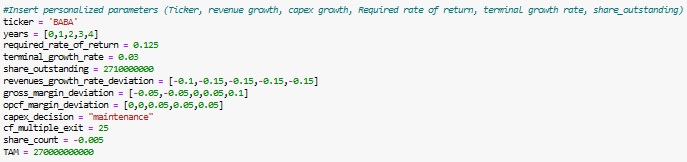
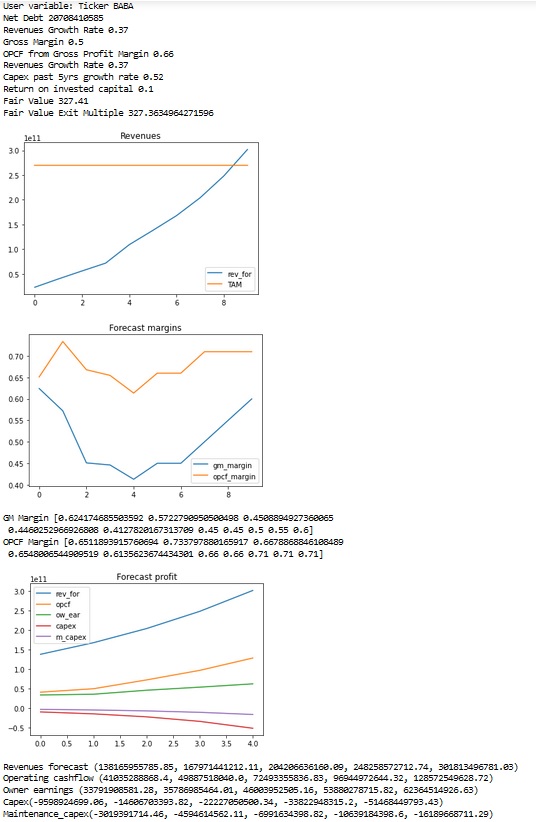
You can find the colab version here.
Or you can simply copy and run the code in your favorite IDE (I used Jupyter Note).
You can use my code to make some changes and experimenting with your companies.
Warning: this code isn’t meant to be brainless, it’s the code version of what we have learned until now, a journey through the math behind our story.
As you can see, it’s all about forecasting the future, with a huge weight towards the terminal value that is the perpetual growth into the future, yes I know, it’s a strange approximation.
Remember before starting to make assumptions
“For superforecasters, beliefs are hypotheses to be tested, not treasures to be guarded.”
Philip Tetlock, Superforecasting: The Art and Science of Prediction
From this deconstruction we can extrapolate some variables worth noticing:
Growth rate:
- Product
- Mindshare (Brand)
Op margin:
- Management ability to reduce the expenses and razionalize the costs
Gross margin:
- Mindshare
- Bargaining power with suppliers
Change in share number:
- Issuance of stocks vs repurchases of stocks (Case Study 2 – Berkshire Hathaway)
- Management capital allocation
Other than that, we understand the role of debt (Balance Sheet). High debt means high costs tied to servicing this debt which implies a reduction of the free cash flow.
Deleveraging (reduction of the debt burden) could be a great sign for a company, it means free up some cash that increases the cash flow and consequently the intrinsic value.
Sell some unprofitable branches or subsidiaries of the business which dilutes the cash generated by the profitables one,
as said by Munger and quoted by Nicholas Sleep:
“Souter began cutting away the weak businesses, a process Charlie Munger, vice Chairman of Berkshire Hathaway refers to as the “cancer surgery approach”. This often works because there is normally a jewel at the heart of most companies that has often been used to fund new ventures or is taken for granted by impatient management. As the jewel becomes diluted by less successful projects aggregate performance declines and valuations atrophy or even fall.”
Nicholas Sleep (The Mentors: Nomad Letters quotes)
When we discover the basic figures involved in the equation, we can create a series of hypotheses and the combination between those in order to define a range of price and better understand what in the future could happen and change our thesis.
What the deconstruction of the DCF analysis tell us, is the importance of qualitative factors, in other words “The story”, indeed the meaning of the qualitative side of the analysis is exactly that: tell us a story which pave the way for the number emergence and survival over the duration of our forecast.
The precision of the future numbers aren’t that important, what really matters is the existence of a story which preserves the Moat and consequently permits those numbers to emerge in some way.
For that reason I’m searching for a simple and profitable business with solid Moats, less assumptions mean a more forecastable feature.
“Numbers alone won’t tell you the answer; instead you must think critically about the qualitative characteristics of your business.”
Peter Thiel, Zero to One: Notes on Startups, or How to Build the Future

Relation between Value and Price
Until now we have analyzed the Value of our stock, we already have discussed the notion of Moat, we had dug through the financial statements all of this in order to try to hypothesize the future cash flow of our company.
But, the ultimate goal of our efforts is to buy a company which will appreciate in the future, then we need a discount in respect to the current price. To enjoy this appreciation we have to buy it undervalued and sell it when the price converges with our estimate.
How that happens?
Here prof Ben Graham helps us:
“In the short run, the market is a voting machine, but in the long run it is a weighing machine.”
Benjamin Graham
In the short run, as greatly explained by the fig. Momentum and mood, group thinking and liquidity (liquidity: it’s the stock easily tradable? Or maybe, because of its size, it’s difficult to buy the stock without affecting the volatility?).
In other words, our psychology and Mr Market (8. Mr Market) psychology affects the price.
But as explained by Graham, over the long term (PATIENCE!!!) the price reverts to the value of the underlying business. I have a suggestion from Mark Twain. It’s a simple phrase but I suggest you think about it, write it down somewhere and reread it when panic arises and you see users on investing forums, your neighbors, your parents, your colleagues start thinking all in the same way, as a herd of lemmings (herd mentality, yes we are animals and our tribes and societies are herds.).
“Whenever you find yourself on the side of the majority, it is time to pause and reflect.”
Mark Twain
And be careful even when some great investors start panicking, maybe there is some reason you don’t know.
Think before acting, even if your favorite investor does something that scares you.
The words
“It’s going to zero along with every other hotel company in the world. … Every hotel is going to be shut down in the country. Everyone,” he said at the time. “Again, I’m a major shareholder. [But] if we allow this to continue the way we allow it to continue, every hotel company in the world is done.”
Bill Ackman
The actions
“Pershing Square manager Bill Ackman turned a net profit of more than $2 billion on Monday after he sold his bets against the market less than one week after warning CNBC that “hell is coming” and imploring the White House to shut down the country for a month
He then used those proceeds to wager that existing Pershing bets, including hotel operator Hilton Worldwide, would rebound.”
source: CNBC
Think about it.
Catalysts
The catalysts are events which bring the Market to evaluate a stock multiple (How much I want to pay for the current/future earnings of this business? Aka P/E).
I personally concentrate my effort on great businesses which compound their cash flow, then the cash flow growth is the catalyst. A good management manages to realize the value through investment with high ROIC, buybacks and special dividends (non-recurring distribution of company assets).
“Mr. Market is there to serve you, not to guide you. It is his pocketbook, not his wisdom, that you will find useful. If he shows up some day in a particularly foolish mood, you are free to either ignore him or to take advantage of him, but it will be disastrous if you fall under his influence. Indeed, if you aren’t certain that you understand and can value your business far better than Mr. Market, you don’t belong in the game. As they say in poker, “If you’ve been in the game 30 minutes and you don’t know who the patsy is, you’re the patsy.”
Benjamin Graham
As Graham said, I try to use Mr. Market’s mood to buy at great price, a good business will take care of itself and overtime earnings and cash flow will force the price to converge.
As this image explains:

ROIC = Cash returns on investment
People = Management aligned with shareholders and motivated employees.
“We like to think we can predict the future and exercise a degree of control over powerful systems such as the weather and the economy. Yet the butterfly effect shows that we cannot. The systems around us are chaotic and entropic, prone to sudden change. For some kinds of systems, we can try to create favorable starting conditions and be mindful of the kinds of catalysts that might act on those conditions – but that’s as far as our power extends. If we think that we can identify every catalyst and control or predict outcomes, we are only setting ourselves up for a fall.”
Farnam Street – “The Butterfly Effect: Everything You Need to Know About This Powerful Mental Model”
Indeed, I trust only one catalyst, a great business which generates tons of cash. I leave the rest of the madness to Mr. Market which gives me some great price to increase my portfolio positions.

CF convergence to Price, that’s thanks to a management shareholder oriented which used Cash Flow to buybacks stocks creating the catalyst for share appreciation.

“man muss immer umkehren” (or loosely translated, “invert, always invert.”)
[German mathematician Carl Gustav Jacob Jacobi]
“[Jacobi] knew that it is in the nature of things that many hard problems are best solved when they are addressed backward,”
Munger Charlie
What are Munger and Jacobi trying to explain here?
As we have seen, some parameters of our business define the price we should’ve been willing to pay.
This is the forward linear:
Variables → Price.
But what if we use the same formula backwards?
Price → Variables.
In other words, play with our formula and try to understand what Mr. Market is implying with the price today.
This could give us some insight about the variables and forecasts implied by the market, which could help us to understand the environment.
At the end of the day it’s all about uncertainty. To rephrase it, when we invest, we are betting on the future and we are trying to protect ourselves by spotting flaws in our cognitive process.
Margin of Safety
I want to briefly introduce this notion, I will dig into it in a future article, but I feel the need to give you this tool.
Now you are ready to look around and search for bargains to buy within your range of fair value. The assumptions used are uncertain therefore the prices are ballpark figures and not precise.
For that reason it’s important to understand the notion of Margin of Safety, Seth Klarman wrote a book on it, then I can’t condense the entire idea in a few words, but the basic idea is to buy with a buffer that takes care of uncertainty and errors tied to our calculation.
We as investors discount the price to preserve/ protect ourselves from our own ignorance. This can be likened to a bridge that is built to support more weight than permitted by the technical specification, despite having to remain solid if, by chance or in error, an overweight truck passes over it.
Yes, we are ignorant and sometimes arrogant, neglect it could be dangerous.

“A margin of safety is necessary because valuation is an imprecise art, the future is unpredictable, and investors are human and do make mistakes. It is adherence to the concept of a margin of safety that best distinguishes value investors from all others, who are not as concerned about loss.””
Seth Klarman
A margin of 5%? 10%? 20%? This is up to you and the story you have created.
Key takeaway:
- The numbers aren’t the whole story
- Herd mentality
- Margin of Safety
Feel free to comment, share my article with friends and subscribe to my newsletter if you like my content and you want to follow me towards financial freedom.
You will obtain free access to my newsletter:
- Financial education
- A open minded and value oriented mindset
- Business and sector analysis
- A stoic and calm attitude towards the market ups and downs
No noise, only signal and high valuable contents
“Everything should be made as simple as possible, but not simpler.”
Albert Einstein
Free investing course index:
Related articles:
Case Study 2 – Berkshire Hathaway
The Mentors: Nomad Letters Quotes
Disclaimer: The information contained on this website is for general information and educational purposes only. It is not intended as a substitute for legal, commercial and/or financial advice from a licensed professional.

Leave a Reply